
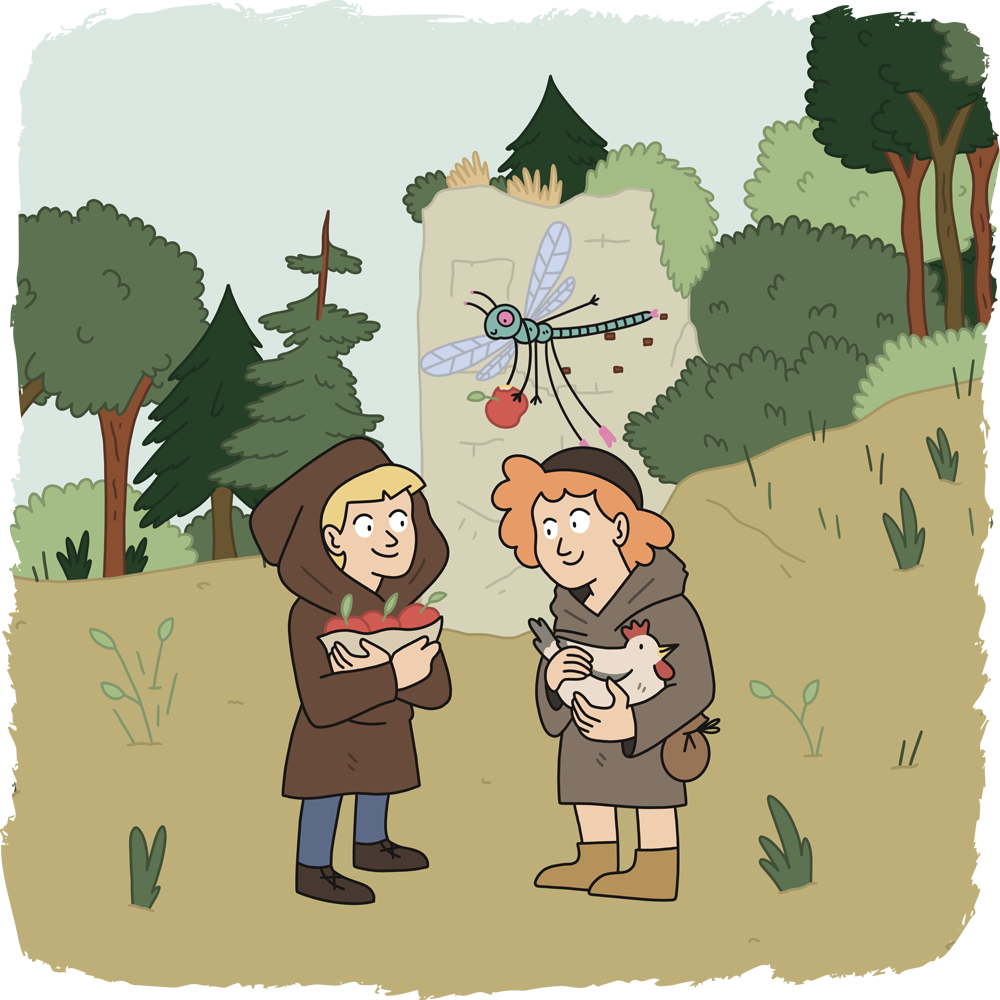

Perched above the gorges of the Sarine, the Lordship of Arconciel emerged in the Middle Ages as a territory where nature and power stood in constant dialogue. The castle, firmly anchored on its rocky spur, and the fortified town that surrounded it formed a strategic ensemble essential for overseeing the valley. Linked to Illens, its sister lordship on the opposite bank, Arconciel controlled forests, pastures and key crossing points.
Over thecenturies, successive lords left their mark on the site through ambition,alliances and sometimes conflict. Around the castle, a true bourg took shape:chapels dedicated to Saint Nicholas and Saint James, a guarded gate watched bya porter, and a communal seal bearing a crenellated tower. Arconciel was notmerely a village, it was a small fortified town.
The lordship also lived to the rhythm of the surrounding mountains and the agricultural granges connected to nearby abbeys, particularly Hauterive. Through donations, tithes, forest disputes and grazing rights, local history reveals a territory where every meadow, clearing and mill tied its inhabitants closely to the land. Place names such as Senayde, Pra Domenjo and La Vignetastill bear witness to this long-standing relationship between landscape andhuman activity.
The 14th century brought a period of crisis: conflicts between lords, interventions from Fribourg and tensions with neighbouring communities. The fortified town gradually emptied, houses fell into ruin and Arconciel-le-Château was eventually abandoned. The population resettled closer to arable land, giving rise to the present-day village of Arconciel.
The 15th century sealed the fate of both strongholds: Illens and Arconciel were captured during the Burgundian Wars in 1475. Integrated into the Old Lands of Fribourg, the lordship entered a new phase. The castle became a stone quarry, providing building materials for the churches of Treyvaux and later Arconciel. The greattower, once a symbol of power, was transformed into sacred architecture, as ifthe stones themselves had chosen to carry history forward in another form.
Today, only the spectral yet majestic ruins remain of a castle that once served as residence, refuge, watch post and seigneurial centre. Yet recent archaeological research, carefully preserved archives and the dedication of local enthusiasts continue to bring this past back to life. They reveal a terroir shaped by rock, water, forests and people, a place where medieval ambitions, rural traditions and collective memory intertwine.
Sources :
- Association du Château d’Illens
- Max de Diesbach, La seigneurie d’Arconciel-Illens (Annales fribourgeoises, 1913).
- Frédéric-Théodore Dubois, Les armoiries d’Arconciel (Annales fribourgeoises, 1913).
